
How many shots should you take a day?
By Matthew Parrott, who makes Tally Hoops ·
You'll hear 500 shots a day, or 100 made threes before you leave, or 1,000 a week. None of them is the right number for everyone. What matters more is how you take those shots, whether you count them, and whether you can keep it up. Here's how to pick a number, and how to track it.
Free to download · iPhone and Apple Watch
Where the big numbers come from
Round numbers travel. "500 shots a day" gets repeated because it's easy to remember and sounds like work. I haven't found research that settles on one daily number, and the figures people quote differ by a factor of five, which is a hint that none of them is a law.
The routines that are documented look different from the lore. In 2018 the San Francisco Chronicle described how Stephen Curry finished practice: 100 shots from behind the three-point line, with one assistant feeding him the ball and another rebounding and keeping a running tally. The column traces the routine to Kyle Korver, whose version was 100 shots from five spots behind the arc. What's worth copying isn't the 100. It's that the routine has the same shape every day and every shot is counted, so one day can be compared with the next. (Curry also had a passer and a rebounder. You probably don't.)
Quality before volume
A shot only trains what you put into it. Shots at game speed, from spots you'd actually shoot from, with your real footwork, are worth more than a pile of flat-footed set shots from a few feet in. If you're working on a change to your form, fewer, slower reps with your attention on that change beat a big number you rush through.
That doesn't make volume worthless. You need reps for a change to stick, and you need enough shots for your percentage to settle (a single 50-shot session of threes can swing about 13 points either way by chance). The goal is the most good shots you can take, not the most shots.
Count makes and attempts
Most "shots a day" advice counts attempts. Some counts makes ("make 100 before you leave"). Track both. Attempts measure the work; makes measure the result; the ratio between them is your percentage, and it tells you whether the volume is still doing you good. 300 attempts at 30% and 200 attempts at 45% both come to 90 makes, but they aren't the same workout.
A week beats a day
I'd take four ordinary sessions over one huge day followed by four days off. Shooting is a skill you keep by doing it often, and a rhythm you can sustain is what lets a trend show up in your numbers. So think in weeks: decide how many sessions you'll shoot, then how many shots go in each. Three sessions of 150 is 450 shots a week, every week, and that adds up to more than one heroic day a month ever will.
Stop where your shot falls off
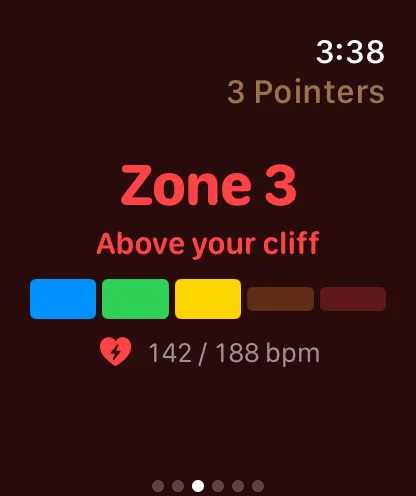
Late in a long session your legs go, your shot flattens, and you start practising a tired version of your form. Some of that is useful, since you'll be tired in games too. But past a point, more shots mostly add misses. Every shot you log on Apple Watch carries your heart rate, and after at least 40 of them Tally Hoops' Fatigue Cliff finds the heart rate where your make rate drops the most, for each shot type. Mid-session, the watch can tap your wrist once you've been past it for 20 seconds: a cue to take a breather or switch to free throws.
How many shots fit in a session
These are estimates, not rules. Shooting alone and chasing your own rebounds, most players manage something like 3 to 5 shots a minute once you count walking to spots and the odd long rebound. A rebounder or a machine speeds that up. Tally Hoops' own drill estimates assume 5 or 6 a minute: a 25-shot Warmup is listed at about 5 minutes and a 100-shot Century Session at about 17.
| Session | Rough total, solo | One way to spend it |
|---|---|---|
| 30 minutes | About 120–150 shots | Warmup drill (25 shots), 75–100 game shots from four or five spots, 25 free throws to finish |
| 45 minutes | About 180–225 shots | Warmup (25), a Century Session (100), 50 from your game spots, 25 free throws |
| 60 minutes | About 240–300 shots | Warmup (25), a Century Session (100), a Conditioning Ladder (50, with sprints between sets), then 75–100 game shots and free throws |
Finishing on free throws is deliberate: you take them in games when you're tired, so practise them that way. The drills are built into Tally Hoops; Warmup is free, and Premium unlocks the rest.
Pick a number you can keep
- Start from your calendar. How many days a week can you really get to a hoop? Two is fine.
- Pick a session size you can finish with good form. If your last 25 shots are much worse than your first 25, the session is too long for now.
- Keep it for three or four weeks. Long enough for the habit to set and for your percentage to show a trend.
- Then add a little. Another 25 shots a session, or one more session a week, not both at once.
Tracking your volume in Tally Hoops
Every session counts makes and attempts as you log them, from Apple Watch or iPhone, and keeps Three Pointers, Free Throws and Freestyle apart. On top of that:
- Goals. Set a Total Makes or Total Shots goal (or Sessions, Practice Days or Practice Time), for all shots or one shot type, and have it repeat weekly or monthly. One active goal is free; Premium allows as many as you like.
- Weekly streak. Choose how many sessions a week count as a week kept, from one to five, and the streak counts the weeks in a row you hit it. Marking a week as resting, traveling or injured keeps the streak safe for free; Premium's Streak Freeze covers a missed week automatically.
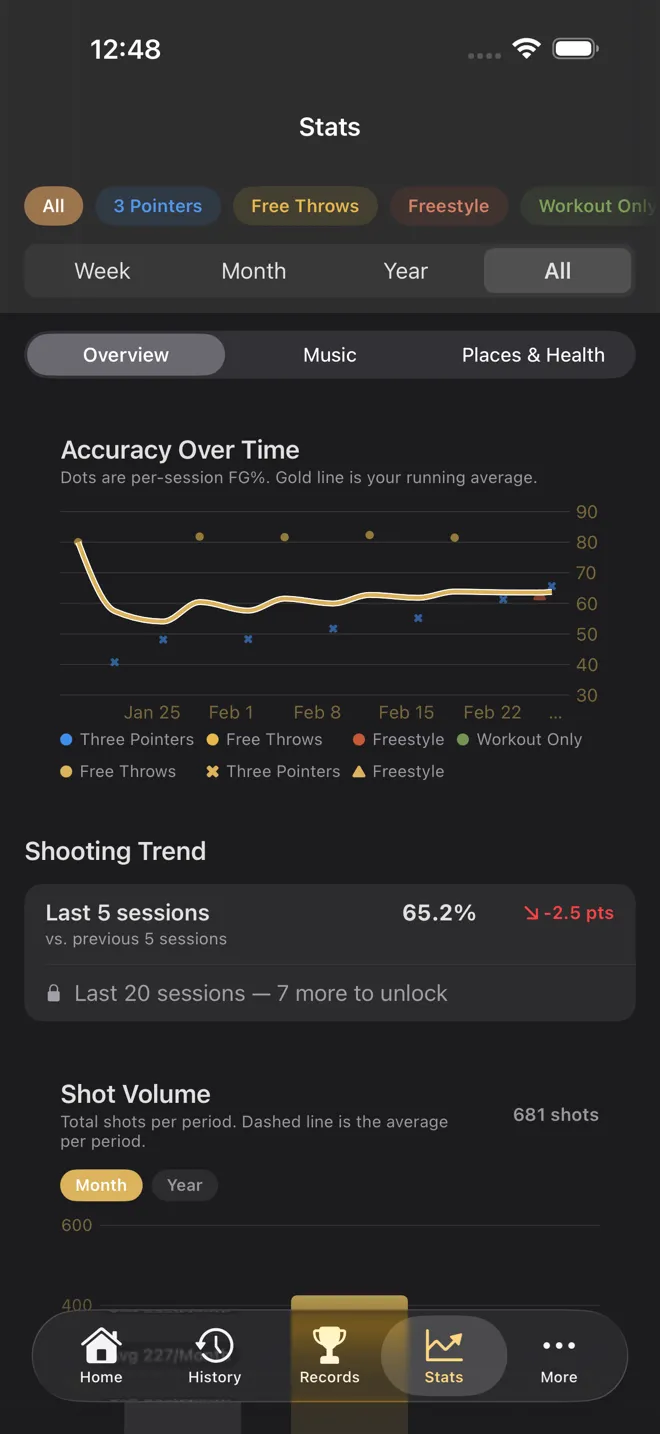
- Shot Volume. The Stats tab totals your shots per day, month or year and draws your average, so you can see whether this month is keeping up with last.
- Milestone ladders. All-Time Shots runs from 500 to 500,000 and All-Time Makes from 250 to 250,000, with ladders per shot type too, such as Made Three Pointers from 100 to 100,000. Every badge and ladder.
- A 7-day training plan built from your own stats, free; with Premium on a device with Apple Intelligence, the plan is written for you by AI.
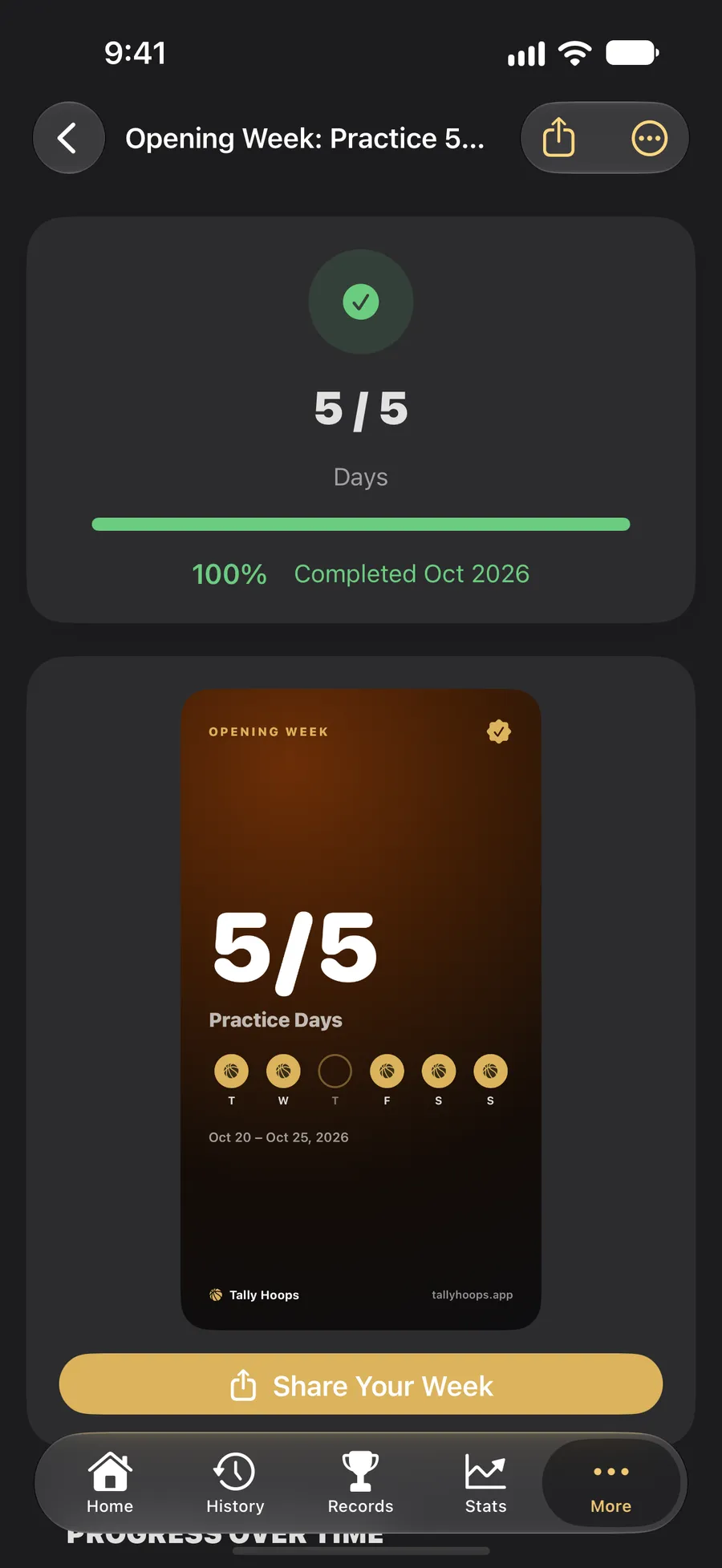
Tally Hoops is free to download, with no account and no ads. If you're tracking threes, the three-point tracker guide explains why they need more shots than you'd think before the percentage settles, and what's a good shooting percentage puts your number next to every level from high school to the NBA.
Sources
- Scott Ostler, "For Warriors' sharpshooter Stephen Curry, practice makes almost perfect," San Francisco Chronicle, June 2, 2018.
Checked against Tally Hoops 3.11 on October 14, 2026.
Questions
How many shots should I take a day?
There's no single proven number. Pick a volume you can repeat every week with game-like form, which for a 30 to 60-minute session is often somewhere between about 100 and 300 shots, count your makes as well as your attempts, and raise the number only once it feels routine.
Is 500 shots a day too many?
Not for everyone, but it's a lot of time: at an estimated 3 to 5 shots a minute shooting alone, 500 shots takes roughly 100 to 170 minutes. If your form or make rate falls apart late, fewer shots at game speed will do more for you than the last 200.
How many threes does Stephen Curry shoot after practice?
A 2018 San Francisco Chronicle column by Scott Ostler described Curry's end-of-practice routine as 100 shots from behind the three-point line, with one assistant feeding him the ball and another rebounding and keeping a running tally.
Should I count makes or attempts?
Both. Attempts measure the work and makes measure the result: a goal on attempts alone rewards rushing, and a percentage on its own hides how much you shot. Tally Hoops counts both for every session and has goals for total makes and total shots.
How many shots can you take in an hour?
Shooting alone and chasing your own rebounds, roughly 180 to 300, at an estimated 3 to 5 shots a minute; with a rebounder or a machine, more. It's a rough estimate: your pace depends on how much you move between spots, how long you rest and how far your misses bounce.